Showing posts with label Marathon. Show all posts
Tuesday, 17 February 2015
Book Review: Miles To Run Before I Sleep, by Sumedha Mahajan
Our ancestors used to run to survive, to hunt food and to escape from predators. Human beings can run for sustained periods of time, unlike all other animals. Running is no longer so important for the modern human being, who lives in an integrated world with such an efficient food supply chain that one can consume all the food one wants without ever setting foot on a farm. We still use our legs and feet to move and it will be a long, long time before they atrophy and become relics of the past, if at all. Even though brute physical strength is no longer so essential for survival, we still enjoy competitions that require speed, strength and stamina. Of the various sports and games that we either participate in or at least watch, running races are among the most popular. We have them in schools and colleges. Almost all multi-sports events ranging from the Olympics to the Asian Games give pride of place to both short and long distance running events. Running events of various lengths, ranging from 10 kilometres to ultra marathons, are held almost all year round, all over the world.
What is it that forces so many otherwise normal men and women to rig their alarm clocks to ring before dawn, slip on a pair of trainers, a few of them very expensive and many not so, and run and run and run, before returning to a standard humdrum existence? What was it that made Sumedha Mahajan, a brave woman who has suffered from asthma since childhood, to run a Greenathon from Delhi to Mumbai, a distance of over 1,500 kilometres, along with five other similarly crazy people? A few months before Sumedha started her Delhi-Mumbai run, she had unsuccessfully participated in the 2012 Standard Chartered Mumbai Marathon. A month before SCMM 2012 which ended as DNF (Did Not Finish), Mahajan was the victim of a hit and run car accident. It was definitely a leap of faith for Mahajan, a leap into the dark, so to say, something the average human being, including yours truly, would not have the guts to commit oneself to.
I found Mahajan’s Miles to Run Before I Sleep unputdownable. Written in simple, functional English, Mahajan has chronicled how she took up running and despite her asthma and other health issues, became a long distance runner who was invited by Milind Soman and others to join a team of six crack runners who would run a Greenathon from Delhi to Mumbai in 30 days, covering a distance of 1,500 kilometres, in a bid to highlight the importance of preserving the environment.
Mahajan’s daily struggle on account of her various ailments and asthma as well as inadequate support from the crew as she ran 1,500 kilometres in 30 days makes Miles to Run Before I Sleep a compelling read. At times I was reminded of Robert Scott’s ill-fated expedition to the South Pole, except that Mahajan was successful and Amundsen’s trek would probably be a better comparison. Mahajan combated bad food, diarrhoea, stress fractures, disputes with the crew, bad weather, unruly highway traffic, pollution and periods. I am not going to disclose more here, but will leave it to you to read this wonderful book for yourself and find out more.
Miles To Run Before I Sleep offers its readers a study in human behaviour. The six runners and their crew set out on their expedition on the best of terms and spirits, all noble intentions and all, but things soon began to disintegrate. The crew was composed of non-sportsmen who did not understand what running is all about. This I think is a common refrain across various sporting events and organisations in India. Almost all sporting bodies are run by non-sports persons, usually politicians. Most marathons are organised by businessmen or politicians who have an agenda. As TRPs generated for the run failed to meet expectations, the journalists accompanying the runners became disinterested. When runners across cities flocked to accompany the six runners for brief stretches, the crew failed to extent any hospitality to the guests. Was this really the crew’s fault, I wonder? Were they warned in advance of the guests’ arrival and were they expected to have additional supplies for the new arrivals? Mahajan does not make this point very clear.
Raj Vadgama was one of the six runners and Mahajan tells us that on Day 25 he had a serious fight with the crew when they served cold coffee – only to Milind Soman and denied it to the other five runners. Soman tried to calm things down, but he was unsuccessful. Vadgama left the team and ran on his own, but he did complete the run. Recently Vadgama has been in the news on account of his Bharathon.
Mahajan’s first marathon was the SCMM 2011. We are told that though Mahajan ran without a clear plan and forgot to hydrate herself for the first half of the race, she ran in under five hours and came 15th in her category. A few months later, she ran a marathon in Malaysia and came 6th. The same year, she ran the 75-kilometre Bangalore Ultra and was the winner in her category. When it seemed that the sky was the limit and the next SCMM was barely a month away, fate willed otherwise and she was hit by a speeding car. An injured Mahajan bravely took part in the SCMM 2012, but did not finish. She also abandoned her plans to run the Comrades Ultra in South Africa, but that did not stop her from accepting Milind Soman’s invitation to take part in the 1500 kilometre Greenathon!
The Greenathon started on 20th April 2012, when summer was already underway. Why didn’t they choose to run in the cooler months, I wondered? Mahajan does not offer any explanation.
Mahajan does not seem to be one of those people who follow specific diets or plans. We are told that as preparation for the Greenathon, she used to eat 500 grams of homemade paneer, a lot of yoghurt, peanuts dates, spinach and fruits daily. Though she does not say so, one gathers that she is a vegetarian, but not a vegan. There is very little discussion about the merits or de-merits of any diet or exercise regime. And that’s not necessarily a bad thing. Listen to your body and eat what you feel like in moderation. That’s me, not Mahajan, though I’m sure Mahajan would endorse my statement.
Mahajan is highly observant and her various comments regarding the places she ran though are very interesting. A number of towns and large sections of the highway were extremely polluted, causing Mahajan to wonder about the cost we are paying for India’s development. The sad truth is that India’s poor are paying a disproportionately high price for this so called modernisation, though they stand to gain little in the short term. In various parts of Rajasthan, Mahajan was an item of curiosity as she ran wearing clothes which were considered unsuitable for women! It was not just illiterate villagers who disapproved of Mahajan's run. Even Mahajan's parents had initially felt that she ought to stay at home and think of having a baby, before Mahajan won them over to her side!
I have a friend who is chauffer driven to work daily. Most days, on his way back, he runs part of the way, around five kilometres and his car trails him. Sometimes he runs the entire distance of around eight kilometres. Though this works well for my friend, the environment gains nothing on account of my friend’s run, in terms of cutting down on fossil-fuel usage and carbon emissions. Most long distance runs are supported runs. The Greenathon runners required extensive support – they were tailed by a large crew in buses and cars carrying their supplies – it could not have been otherwise, though the idea was to draw attention to environmental issues and the need to preserve the environment. In an ideal world, a really fit runner ought to be able to run from Delhi to Mumbai, taking breaks on the way, buying food and water from clean wayside restaurants and dabhas, serving hygienic food and water. “You may say I'm a dreamer, but I'm not the only one. I hope someday you'll join us. And the world will live as one.” I’m sure Mahajan would endorse this quotation.
Wednesday, 12 February 2014
Running Shoes: How cheap can one get?
I’ve always been a firm believer in keeping my work-out costs low. I’ve never been a member of an expensive gym or spent much on exercise attire. And when it comes to running shoes, the most I’ve spent was fifty pounds (around Rs. 4,000 in 2007) on a pair of New Balance shoes, which I used for around four years, including for my first full marathon at the SCMM 2012. Since mid-2012, I’ve been running on a pair of Reeboks for which I think I paid Rs. 2,200. My Reeboks are still in good shape though I run around 60-100kilometres per month on average. With my trusted Reeboks, I ran the Vasai Virar Mayor’s Marathon in October 2013. In addition, I have run five half-marathons in the last 18 months.
Sometime last November, I bought myself a pair of very cheap running shoes, with the intention of testing the thesis that expensive shoes are not necessary for a runner. After all, until India’s economy liberalized and imported goods started to pour into the country, didn’t those few Indians who went jogging run with such shoes? Didn’t we all wear those cheap white shoes (from Bata) for our PT classes at school? I was fairly confident that that I would be proved right and that I wouldn’t suffer any ill effects on account of switching to a much cheaper pair of shoes.This despite the fact that I am almost flatfooted and at one point in time, many years ago, had developed plantar fasciitis. I had been planning to experiment with a pair Bata PT shoes for sometime, but hadn’t been able to get hold of a pair since the Bata shops I visited didn’t stock them. Therefore, when while shopping for a school bag for my daughter, I saw a pile of Hi Fly shoes wrapped in polythene wrappers stacked up in a corner, I couldn’t help but buy a pair. It cost me all of Rs. 235.
The very next day, I went for a run wearing my new shoes. I decided to play it safe and stuck to my basic route, which is around 5.5 kilometres – from home to Carter Road, a single loop up and down the Carter Road Promenade and back home. My feet were instantly transported to a hard new world, one where every small pebble on the ground made a small impact, where my feet could easily make out the difference between sand, clay, gravel, asphalt and concrete. When after doing a few pull ups or dips on the exercise bars put up alongside the Carter Road Promenade (at the Khar end), I dropped a few feet to the ground, my feet felt the pressure almost as if I were barefoot. I enjoyed the new tingling feeling on my soles, despite the need to watch every step I took.
The next day, I did an extra loop of the Carter Road Promenade, which meant I ran around 8 kilometres and when I finished, I felt some pain around my shin bones and knees. I started to worry and gave myself a break of 2 clear days. Nevertheless, on the third day, I did three loops of the Carter Road Promenade, which meant my total mileage was around 10.5 kilometres. This time, there was no mistaking the pain in my knees, soles and shin bones as I finished my run.
I started wondering if my cheap running shoes would really work for me. I took a break of 3 clear days and ran 8 kilometres. The pain persisted. Another break of 3 clear days and the fourth day, I did my basic 5.5 km run, with a single loop of the Carter Road Promenade. The pain lingered and I was forced to take a week’s break from my morning runs.
When I started again, I wore my Reeboks and felt much better, though the discomfort lingered in a mild form. Two weeks later, my wife and I celebrated a new arrival in the family and I didn’t go jogging for the next two months, other than running around the flat, changing nappies etc.
Two weeks ago, I started again, wearing my Reeboks. The first week, I took it easy, doing basic runs of 5.5 kilometres every alternate day. This week, I’ve been running 8 kilometres per day, on alternate days. The pain in my legs has entirely subsided, though my knees still feel wobbly when I start my run each morning. I’m told that if one hurts one’s knees, the injury never fully heals, just as in the case of back injuries. I hope that my brief experiment with those beautiful Hi Fly shoes does not result in everlasting damage to my knees or other leg joints.
Now with that lesson behind me, I am wondering if I should gift myself a pair of Ascis, reputed to be the best running shoes, thought not too easy on the wallet. I think I will, before the next SCMM. As for those cheap Hi Fly shoes, I have packed them up and put them in a basket, knowing I’d never run with them again – I couldn’t bring myself to throw them away. It is quite possible that those might work for a runner who is a natural athlete with the right sized arches under his or her soles. If anyone wants to borrow them from me, please contact me and you may have them, provided you promise to treat it as a permanent loan and not return them to me.
Sometime last November, I bought myself a pair of very cheap running shoes, with the intention of testing the thesis that expensive shoes are not necessary for a runner. After all, until India’s economy liberalized and imported goods started to pour into the country, didn’t those few Indians who went jogging run with such shoes? Didn’t we all wear those cheap white shoes (from Bata) for our PT classes at school? I was fairly confident that that I would be proved right and that I wouldn’t suffer any ill effects on account of switching to a much cheaper pair of shoes.This despite the fact that I am almost flatfooted and at one point in time, many years ago, had developed plantar fasciitis. I had been planning to experiment with a pair Bata PT shoes for sometime, but hadn’t been able to get hold of a pair since the Bata shops I visited didn’t stock them. Therefore, when while shopping for a school bag for my daughter, I saw a pile of Hi Fly shoes wrapped in polythene wrappers stacked up in a corner, I couldn’t help but buy a pair. It cost me all of Rs. 235.
The very next day, I went for a run wearing my new shoes. I decided to play it safe and stuck to my basic route, which is around 5.5 kilometres – from home to Carter Road, a single loop up and down the Carter Road Promenade and back home. My feet were instantly transported to a hard new world, one where every small pebble on the ground made a small impact, where my feet could easily make out the difference between sand, clay, gravel, asphalt and concrete. When after doing a few pull ups or dips on the exercise bars put up alongside the Carter Road Promenade (at the Khar end), I dropped a few feet to the ground, my feet felt the pressure almost as if I were barefoot. I enjoyed the new tingling feeling on my soles, despite the need to watch every step I took.
The next day, I did an extra loop of the Carter Road Promenade, which meant I ran around 8 kilometres and when I finished, I felt some pain around my shin bones and knees. I started to worry and gave myself a break of 2 clear days. Nevertheless, on the third day, I did three loops of the Carter Road Promenade, which meant my total mileage was around 10.5 kilometres. This time, there was no mistaking the pain in my knees, soles and shin bones as I finished my run.
I started wondering if my cheap running shoes would really work for me. I took a break of 3 clear days and ran 8 kilometres. The pain persisted. Another break of 3 clear days and the fourth day, I did my basic 5.5 km run, with a single loop of the Carter Road Promenade. The pain lingered and I was forced to take a week’s break from my morning runs.
When I started again, I wore my Reeboks and felt much better, though the discomfort lingered in a mild form. Two weeks later, my wife and I celebrated a new arrival in the family and I didn’t go jogging for the next two months, other than running around the flat, changing nappies etc.
Two weeks ago, I started again, wearing my Reeboks. The first week, I took it easy, doing basic runs of 5.5 kilometres every alternate day. This week, I’ve been running 8 kilometres per day, on alternate days. The pain in my legs has entirely subsided, though my knees still feel wobbly when I start my run each morning. I’m told that if one hurts one’s knees, the injury never fully heals, just as in the case of back injuries. I hope that my brief experiment with those beautiful Hi Fly shoes does not result in everlasting damage to my knees or other leg joints.
Now with that lesson behind me, I am wondering if I should gift myself a pair of Ascis, reputed to be the best running shoes, thought not too easy on the wallet. I think I will, before the next SCMM. As for those cheap Hi Fly shoes, I have packed them up and put them in a basket, knowing I’d never run with them again – I couldn’t bring myself to throw them away. It is quite possible that those might work for a runner who is a natural athlete with the right sized arches under his or her soles. If anyone wants to borrow them from me, please contact me and you may have them, provided you promise to treat it as a permanent loan and not return them to me.
Wednesday, 13 November 2013
Notes from the Vasai Virar Mayor’s Marathon 2013

It’s been a little over two weeks since I ran the Vasai Virar Mayor’s Marathon 2013 (VVMM). Three of my toe nails are still bluish-black (I think I will lose them) and my hopes of running a sub-five marathon lie shattered. This was my second full-marathon – I had taken 5:24 hrs to complete the Standard Chartered Mumbai Marathon 2012 (SCMM) and I thought I would easily do the VVMM in under 5 hours. I had trained reasonably well and everything was fine for the first half. The crowds were lovely and lined the entire road from Virar till Vasai. There were school kids out with banners, dressed in their school uniforms, most definitely instructed to turn up by their schools, there were housewives in their night gowns, men with stubbles, rubbing off the sleep from their eyes and even a few groups of ethnically dressed performers, dancing to the beat of drums and dholaks. There were water stations every kilometre or so and at a few places they even handed out oranges and biscuits. The route was very scenic – parts of it reminded me of Kerala’s landscape. As we ran, we could hear church bells peal at a number of places as the good people of Virar and Vasai attended Sunday mass.
I crossed the half-way mark in around 2:20 hrs and then things started going downhill. Unlike the SCMM which starts at 5:45 a.m., the VVMM started at 6:45 a.m. I guess it couldn’t be helped since a large number of runners are from Mumbai and it takes a while to reach the starting point at Virar. Secondly, the SCMM is held in January, whilst the VVMM is in October, the peak of what can be called Mumbai’s second summer. It’s hot and humid and there are long stretches with no shade. The third big difference between the SCMM and the VVMM, and this is a really big one, is that for the former, the roads are closed to traffic for the entire 6 hours one is given to complete the full marathon. At the VVMM, the roads were opened to traffic barely two hours after the marathon started. By 10:30 a.m., traffic was in full flow.
I guess this happens in all tier two marathons. The second half of the run was pure hell. It was not just on account of the traffic, heavy enough at times to force me to walk rather than run, or even the weather. As I started to run back towards Virar from Vasai, the water stations started to disappear. Even the many balloon bunches that lined the route, which I relied on for directions, were taken down much before the 6-hour cut-off. I once lost my way a little bit and ran for around 200 metres in the wrong direction before someone corrected me and sent me back. At a few places, I had to stop and look for signs or ask for directions before running on. Towards the end, around one kilometre before the end, I saw a runner ahead of me fail to take a u-turn (because the signs weren’t clear and there was no one around to direct him) and run a hundred odd metres extra before he turned back. The sweeper van meant to pick up stragglers who wanted to drop out was in operation much before the 6 hour deadline. I was asked at least three times by enthusiastic young men if I wanted a ride to the finishing point, something I found to be very dispiriting to say the least. The first time I was asked was around the four hour mark, when I was going strong, at least so I felt. Once on a crowded pavement, a man asked me if I would like to sit down, rest and eat something. It took me a second to realise that I was talking to a shop-keeper and move on. These little things do matter. Marathons are not just for the elite runners. I feel that that the organisers ought to have considered the recreational runners who make up the bulk of the participants before shutting shop so early. On the positive side, there were pilots on motor-bikes who darted back and forth and supplied us with directions and water (which made up for the absence of water stations) till the end.
I thought of giving up many times, but ultimately I didn’t. For personal reasons, I won’t be able to take part in SCMM 2014 and I needed to complete the VVMM within the cut-off time to be eligible for SCMM 2015. I tried to motivate myself by imagining that I was a Viet Cong guerrilla running along the Ho Chi Minh trail, a Spetsnaz commando on a killer mission, a US Navy SEAL running stealthily behind enemy lines, an NSG Black Cat Commando on a mission to free hostages held by suicidal terrorists, a warrior in a Zulu impi marching towards Isandlwana. None of that really worked. Ultimately I finished just inside the cut-off time because I had posted details of my run on facebook and didn’t want to lose face in front of my facebook “friends”. I ran because I didn’t want to tell my office colleagues that I couldn’t last the course and had chickened out. I ran on, a week after my 39th birthday, fuelled by my ego and the painful awareness that it would cost me a lot to prepare for and run a full, timed marathon once again before registrations started for SCMM 2015.
I completed in 5:49:10 hrs, wearing bib number 205. My results, with splits etc., are available on this site. Please choose Vasai – Virar Marathon 2013 and enter my bib number 205 for my results.
I am unable to write about an event like this without a few words regarding the toilet facilities, in my opinion one of the best criteria to judge organisers of such events. I got to the starting point around fifteen minutes before kick-off and asked for the nearest toilet. I was directed to one inside the large building to my right. It looked dirty with what looked like a large piece of human dung inside. I gingerly prepared to pee and the large piece of dung moved, trying to jump out. It was a frog! To be fair to the organisers, that toilet was not meant for the participants. Enroute, I found a set of portable toilets around the fifteen kilometre mark. Neat, clean and easy to use, I never saw another set of such toilets till I finished and entered the resting place for the participants, which had a similar set of toilets. However, I didn’t need to use a toilet on the return leg since it was so very hot and humid. I wouldn’t have minded if I could have relieved myself much before the fifteenth kilometre, but the entire route was so lined with cheering people that I never found a spot where I was by myself with some cover.
Before I conclude, there’s one special request I have for the organisers. During the first half of the marathon, along with the crowds that lined the route, there were loud speakers belting out popular music. Even when the crowds weren’t there, especially as we neared the half-way mark, loud speakers played songs at full blast. I can’t say I am speaking on behalf of all runners, but for me, when I run, silence is a blessing and loud music is something I treat on par with air pollution from vehicle fumes. The loud music played from those speakers gave me a headache. Please note, I am not talking of the sounds made by those cheering kids or even the drummers. I am only talking of the large black loudspeakers which made such a racket for the entire 21 kilometre stretch during the first half. Please dispense with them for the next event, if you don’t mind.
Sunday, 19 August 2012
Notes from the 3rd Borivali National Park Half Marathon
I had run the Standard Chartered Mumbai Marathon in January this year and so when I signed up for the 3rd Borivali National Park Half Marathon, I thought it would be a piece of cake. I mean, if I could run 42.195 kilometres, then I ought to be able to effortlessly run 21.0975 kilometres without breaking into a sweat, or so I reasoned. I just hadn’t factored in the terrain at the Borivali National Park (BNP). Two days before the run, someone asked me how much time I expected to take to complete the half- marathon? ‘2:20 or so,’ I casually replied. When I ran the Standard Chartered Mumbai Marathon in January, I had taken around that time to cross the half-way mark. Since then, I have trained sporadically, the intermittent nature of my morning runs more on account of my work and other hobbies than due to sloth.
The day of the marathon, I took a cab to the BNP and got there by 5:30 a.m. The marathon was expected to commence at 6:15. There was a huge crowd of runners attired in all sorts of gear, milling around the entrance. Why haven’t these folks gone in? I wondered. I would soon have the answer.
The BNP, now formally named Sanjay Gandhi National Park, allows pass-holders to enter the park from 5:30 a.m. onwards. If you don’t have a pass and need to buy a day ticket, you won’t be allowed entry till 7:30 a.m. The organisers of the BNP Half Marathon had obtained permission for us to enter from 5:30 a.m. onwards, but the chaps manning the gates at the BNP had different plans that morning. We waited and waited for sense to prevail. A few runners left. I got tired of standing around and walked over to the other side of the highway and bought myself a litre of water from a stall which had just opened.
Finally by around 7:00 a.m., it started drizzling and all the runners took shelter under a flyover which is in front of BNP’s entrance. A few minutes later, we were allowed to enter the BNP.
If I had done some research, I would have known that the terrain at the BNP is hilly with elevations between 30 m (98 ft) and 480 m (1,570 ft). For the 21.0975 kilometre run, we were expected to run an uphill course of 5.5 kilometres, return to the starting point and then repeat the same. I wasn’t carrying any water and the only energy supplement I had was half a packet of chocolate balls, which my five year old had discarded. The organisers had promised to make available sufficient water, Gatorade, biscuits, bananas and dates enroute. They were as good as their word and I did not regret my decision to not carry any water.
Once the race started, I forgot my irritation at having had to wait outside and the delay of over 1.5 hours. Nothing really mattered once I was running and was surrounded by scores of other runners. It started raining again. I wished it would rain heavily, but it was at best a heavy drizzle, which would peter out and start again. The BNP is used by many people, especially senior citizens, for their daily constitutionals. Buses ply inside and there are a few cyclists as well. Since it was drizzling and everything was slushy, there were minor traffic jams and the runners had to slow down at times to give way.
At home in Bandra, my usual jogging course takes me up and down the steep Pala Mala road, as it leads to and from Carter Road. I could therefore justifiably claim that I had done some training on a 'slope'. However, the truth is that I had not fully prepared for running the steep incline at the BNP. I do wish I had prepared myself better, by doing some additional ‘hills’. Despite that, I am happy to say that I ran the first leg of the marathon without any breaks. Towards the end of the first leg, we were faced with a really steep climb of around 300 metres. Like many others, I walked that bit. The return trip was relatively easy since it was mainly downhill. When I started to run the third leg of the race, my lack of preparation became woefully clear. I stopped a few times to take a few deep breaths. I took two ‘walk breaks,’ walking a few hundred metres each time. My back started to hurt.
As I have detailed in this post on running my first (and only) full marathon, I am almost flat-footed and I have a back problem which flares up once in a while. I ignored the back pain and took extra care to land mid-sole. Slowly the back pain disappeared.
Then by around the 14 kilometre mark, I got my second wind. The last leg was relatively easy, especially since I knew that the end was neigh. I was greeted at the finish line with a medal and some refreshments in the form of a banana, a cupcake and a sealed packet of poha. I found out from a couple of very kind volunteers that I had taken 2 hours and 46 minutes to complete the half-marathon.
Post note: Many thanks to Ashok Someshwar who took the photograph which appears above and for giving me permission to post it on this blog.
Tuesday, 1 May 2012
How I Ran The Standard Chartered Mumbai Marathon With My (Almost) Flat Feet And A Bad Back
Flat, Flat Feet
I am almost flat-footed, always have been. I remember enthusiastically participating in every running race at school and coming last in each and every one of them. The only time I won a prize in any sport or game (other than chess) was when I came first in a sack race. I was around eleven and had devised a method of dragging my feet through my sack (which was the widest entered in the race) rather than jump forward, as everyone else did.
Puppy Runs
I started jogging in the mornings when I was around fourteen and I used to consider a lap of two kilometres to be a decent effort. I remember going for a run with a friend one morning. ‘Heel first and roll on to your toes,’ my friend told me in an authoritative voice and I followed suit. I continued to land heel first for many, many years afterwards. As I grew a bit older, I switched to push-ups and dumbbells and stopped running. Later I joined a law school in Bangalore which was conveniently close to the Sport Authority of India’s Southern Centre (SAI). I enrolled for Judo classes at SAI, which was just a kilometre or so from my hostel. In the mornings, I would jog from my hostel to SAI, practice judo and jog or walk back depending on how tired I was. Though I was diligent, I wasn’t particularly good at Judo and had to put in some extra time on my own just to keep up with the others. After three years, the Judo coach at SAI got transferred to some other sports centre and wasn’t replaced. After that, I stuck to working out in the gym. I got myself a bicycle and would cycle to SAI and back and stopped jogging altogether.
Good Morning Back Problem
One day while doing a set of Good Mornings with 40 kilograms on my shoulders, I hurt my back pretty badly. I was in my final year and a few months away from leaving my law school hostel. After a few weeks off, I went back to the gym but from then on, avoided doing heavy weights.
Lawyering and Running
Once I started working as a lawyer in Mumbai, I had very little free time and barely managed to visit a gym for 30 minutes or so in the mornings before I went to work. I worked six days a week and sometimes ended up in office on Sundays as well. Once every few weeks, on the rare occasion when I got off work early or on a Sunday evening, I would go running around the Oval Maidan – I stayed in Colaba in those days, initially in the YMCA and later as a paying guest. Usually, I would manage a couple of rounds around the Maidan, always landing hard on my heels. Once in a blue moon, I would run three rounds and that would make me very happy, as if I had accomplished something substantial.
Slipped Disc
After four years in Mumbai, I decided to go to the UK to study at the LSE. After packing up from Mumbai, I took a train to Kerala where my parents live, planning to spend a couple of weeks with them before going to London. On the train, a few hours before reaching my destination, I suffered a ‘slipped disc’. I had lifted my hand to take a blanket from the upper berth, everything was fine for a moment and suddenly I was breathless with pain. I somehow managed to get out of the train at Kottayam. Some kind souls helped me offload my luggage. I spent the next two weeks in bed, but still managed to catch my flight to London!
In A Country Of Fitness Freaks
As a student in London, I had subsidised access to the London University’s swimming pool in the ULU Building and for a whole year, the only exercise I took was my daily swim. Up and down an Olympic sized pool for around forty or fifty minutes daily, I must say that I found it pretty boring. It was after I started working as a solicitor in London that I started jogging once again, alternating it with gym sessions and weekend swimming. I continued to land heel first.
The percentage of Britons who are bitten by the fitness bug is far, far higher than in India. Also, things are a bit more organised out there and it is relatively easy to make time for regular exercise. It is very common to see office workers go for a jog in the afternoon just before lunch. Most offices have showers for employees. Also, the cool weather makes it easier to run longer distances. One doesn’t sweat as much as in India and provided one is warmly dressed, one doesn’t get as much tired.
While in London, my back problem flared up a few times, usually when I picked up something heavy, like a suitcase or a piece of furniture. A couple of weeks’ rest would see the pain subside and I would be back to my normal exercise routine.
Marathon Dreams and Plantar Fasciitis
The annual London Marathon is a very popular event, a lot more popular than the annual Mumbai Marathon. A number of colleagues at the law firm I worked for were taking part, all of them raising money for charity at the same time. I was hooked as well. I slowly cut down the time I spent in the gym and increased the length of my bi-weekly run. I was soon running about 7 or 8 kilometres at a stretch, twice a week. I kept increasing the distance I ran. When I crossed the 10 kilometre mark, I developed a pain in the sole of my feet. I stopped running and the pain went away. It started all over again when I ran more than 10 kilometres at a stretch. I was puzzled and devastated. I consulted a few friends at the gym and the name Plantar Fasciitis cropped up. I assumed that I had developed Plantar Fasciitis because I was almost flat-footed.
New Shoes
I bought myself a new pair of fancy New Balance shoes from the London Marathon Store at 63 Long Acre in Covent Garden. The store made me run a few yards on a ramp fitted with sensors and analysed my running style before they sold me the shoes I have been running in ever since. I was told I was landing too heavily on my heel (not really surprising) and that the extra cushion in the New Balance shoes would reduce the effect of that impact. That ought to have set me thinking, but it didn’t. I continued landing on my heel, secure in the knowledge that the impact was being cushioned. I continued to develop a pain in my sole every time I crossed the ten kilometre mark. I continued to assume that I wasn’t able to run longer distances because I was almost flat-footed.
Heel Versus The Mid-Sole
I lived in the UK for eight years altogether and returned to India in December 2010. I started working in Mumbai from the beginning of January 2011. Pretty soon after I reached Mumbai, the Standard Chartered Marathon took place and once again I found myself wishing I could do a full marathon. Just as I was planning to consult a sports doctor to find out if I could do anything to fix my flat-footedness and prevent a recurrence of the dreaded Plantar Fasciitis, I came across an article on the internet which debated the merits of landing on the heel versus the mid-sole and the toe. Whoa! It was as if I had been suffocating to death and someone gave me a lungful of fresh air. According to that article, landing on the heel doesn’t work for many people, and I guess I am one of them. Why didn’t someone tell me about all this before? I wondered. I had been an idiot all along! I searched and found a lot more articles on this topic, such as this, this and this.
On The Marathon Track
Until April 2011, I was unbelievably busy, trying to sort out a number of things including my daughter’s admission to a Kindergarten. Once the school admission was taken care of, I was able to rent a house close to the school and move my wife and daughter to Mumbai. Once I settled down, I started jogging once more, this time taking care to avoid landing on my heels, using my mid-foot instead. And it worked. I was able to cross the 10 kilometre barrier without suffering any ill-effects. I was soon running between 30 to 40 kilometres a week. In August, I went ahead and registered for the full-marathon race, though I wasn’t sure I would be able to go the whole hog.
I continued jogging with increased vigour, taking extra care not to land on my heels, still apprehensive that my soles would start hurting again. Luckily it didn’t. I played it safe by giving my legs a 24 hour break after every two dozen kilometres or so. Most days I ran around seven kilometres. I would run from my flat to the Bandra end of Carter Road, run up and down the Carter Road promenade twice and then run back home. The monsoon disrupted my training to some extent. A few times, I went running in the rain, but ending up catching a cold after a couple of runs. After catching a cold for the second time, which developed into a cough and lasted over week, I stopped running outside if it was raining. Instead I switched to running up the stairs in my building, taking care to make as little noise as possible. Thankfully, no one complained.
Chickening out?
In the middle of December, I ran a little over twenty kilometres at a stretch. It was the longest I had run till then and took me around 2:30 hours. At the end of that run, I was exhausted. In fact, I was so exhausted, I was convinced I could not complete a full marathon. I enquired if it would be possible to run the half-marathon after having registered for the full one. I received a polite no.
I spent Christmas with my parents in Kerala and went on a week’s vacation in Sri Lanka after that. I didn’t do any jogging in Kerala and in Sri Lanka I went jogging on Bentota beach a couple of times. My tapering down had begun a little earlier than it should have!
The Jeff Galloway Technique
A week before the marathon, I read about the Jeff Galloway tactic for running a marathon. Not for elite runners hoping to crack the existing world record, this technique developed and made popular by Jeff Galloway, a member of the 1972 US Olympic team, advocates that marathon runners ought to take frequent walk breaks, right from the first kilometre, in order to perform better.
I suddenly started to feel confident of completing the marathon. By my estimate, I was taking around 7 minutes per kilometre. Assuming I could maintain the pace for the entire 42 kilometre stretch, I would take around 300 minutes or five hours to complete the run. Of course, I was going to take longer since I planned to take a lot of walk breaks. The organisers had imposed a deadline of six hours to complete the full marathon. Six hours after the commencement of the race, they proposed to open the road to vehicular traffic. Also, runners who took over six hours to cross the finish line would not receive timing certificates. I grimly promised myself that come what may I would keep moving forward for six hours, after which, if I hadn’t reach the finish line by then, I would turn around and take a taxi home.
Gels and electrolytes?
A few days before the marathon, I decided to buy myself a waist band with pouches for carrying gels and bottles of water or electrolytes. However, deciding to buy such a waist band and actually buying it are two different things. I went to a few stores in Colaba, Nike, Reebok, Adidas etc., and they had all run out of waist pouches. Most probably, a number of other marathoners had made a similar decision and acted on it before I did. I ended up buying a small bag which could be worn across my shoulders and would carry a bottle of electrolytes and some chocolate bars or gel sachets. I tried running with that bag and it wasn’t too bad. But it wasn’t too comfortable either. I was then advised by a good friend who had run the Standard Chartered Mumbai Marathon earlier that the water, soft drinks and electrolytes provided by the organisers and the chocolates and biscuits provided by well-wishers enroute, were more than adequate for the average runner. I decided to count myself as an average runner and ditched the shoulder bag I had purchased. I bought a few Mars bars and Dairy Milk chocolate bars, enough to fill one of the pockets of my trousers and left it at that. The other pocket carried my mobile phone and some money wrapped up in polythene.
Final Paperwork
Two days before the marathon, I went to the Bandra Kurla Complex and collected my running bib, timer and a goody bag which had a number of pamphlets and sample sachets of health and beauty products. The latter include a fairness face wash, which I decided to save for a special occasion and am yet to use even now.
Carb-Loading
The best part of running the marathon was the loading up on carbohydrates on the day prior to the race. I used to be a big eater when I was much younger. Over a period of time, I have intentionally cut back on my diet considering the fact that I don’t exercise as much I would like to and I am much shorter than the average Indian. The day prior to the race, I started with a breakfast of three fried eggs and a few slices of toast and topped up with some oatmeal porridge. I had chappatis, dal and chicken kebabs for lunch. I ended with an early dinner of curd rice, prawns and some vegetables. It was guilt-free eating and good fun.
15 January 2012
On the morning of the race, I woke up at 4:00 a.m., ate a couple of boiled eggs and two pieces of toast with jam. A pre-booked taxi took me to Azad Maidan at CST where all runners were advised to assemble at least an hour before the race commenced at 5:45 a.m. A number of mobile toilets were parked at one end of the maidan and I used them a couple of times, because I wasn’t too sure about the toilet facilities enroute. The toilets were reasonably clean, though the floor was wet and I was glad I wasn’t one of those running the marathon barefoot. I did see one barefoot runner with a pair of chappals tucked in a band around the waist, for use at toilets.
Finally, Am On My Way
We started running towards the start line in a big mob and I crossed the start line at around 5:41 a.m. I guess it is not physically possible to have all runners cross the starting point at the same time. The timing chip tied to my shoe would record the time I started the race and the time at which I crossed various points enroute and my final finish time.
Familiar Landmarks, Comfortable Running
I felt calm as I ran towards Flora Fountain, to Nariman Point where I work, past the Air India building and through the Marine Drive towards Pedder Road, Worli and beyond. I ran without a break for the first five kilometres when I came across a public toilet. I also didn’t stop for any water until I had relived myself once. I did see a number of runners help themselves to water and electrolytes at water stations from the third kilometre onwards. I ran comfortably till I reached the Bandra Sealink at Worli, a distance of around 14 kilometres. From then on, I started taking walk breaks every two kilometres or so.
Jokes Fly As I Cross The Bandra Sealink
Running over the Bandra Sealink, which was closed to traffic, was good fun and there were jokes flying around aplenty. A man running next to me pointed to a message from the traffic police which was flashing up ahead. ‘Do Not Overtake’ it admonished us. The 50 kilometre speed limit sign flashed overhead all the time and I kept wishing I could run at half that speed.
No Turning Back
After crossing the Sealink, I reached Bandra in around 2:20 hrs and turned around to begin the long journey back to Azad Maidan. At that point, it was so tempting to stop running and take an auto rickshaw home. I am glad I didn’t. I was very pleased with the fact that I had reached the half-way mark in 2:20 hrs and started to dream of finishing the marathon in less than 5:00 hours. Unfortunately I hadn’t trained as well as I ought to have had. Also, it might have been a good idea to take walk breaks right from the beginning rather than after the first fourteen kilometres.
After I crossed the 28-kilometre mark, I started taking walk breaks after every kilometre. I would stop running when I neared the kilometre milestone and walk till I crossed the mark which usually had a water station. I helped myself to water at every alternate water station.
The Elite Runners
On my way back, somewhere between Mahim and Dadar, the elite runners who started their race a couple of hours after us amateurs, raced past. With bodies made for running, they sped past us in a blur, their legs churning effortlessly, reminding me of the vast gulf between myself and the top runners.
Hitting The Wall
I hit the wall at around the 32nd kilometre. By this time, the front part of both my feet felt numb and rather heavy. I considered sitting down somewhere, taking off my shoes and massaging my feet. However, I was scared that if I sat down, I would never get up and so I plodded on. I motivated myself by trying to imagine how after completing the run I would boast to all and sundry that I had completed the Mumbai Marathon. It worked to some extent. I then tried to imagine how it would look if I didn’t complete and had to explain to my friends and colleagues that I had chickened out at the final lap. That tactic worked a bit better.
The Final Stretch
I started feeling better after I crossed the 36th kilometre mark. I don’t want to use the word ‘second wind’ since I don’t think I ran any faster after that, but the feeling of despair and fatigue sort of slipped away and I pressed on. Once I was back on the Marine Drive, I started feeling exultant and euphoric. It was all I could do to not start celebrating right then and there. Once I exited the Marine Drive and ran past Not Just Jazz By The Bay and the Ambassador Hotel, I knew that I had won. But I hadn’t. Yet. It took my weary feet another fifteen odd minutes to get to within sight of the finishing tape. I had planned to hold up my hands shoulder high as I crossed the finish line and I thought I did just that, but the photograph I got from the organisers show my hands lifted up waist high. I guess I was too tired to lift up my hands properly and didn’t even realise it.
Final Timing
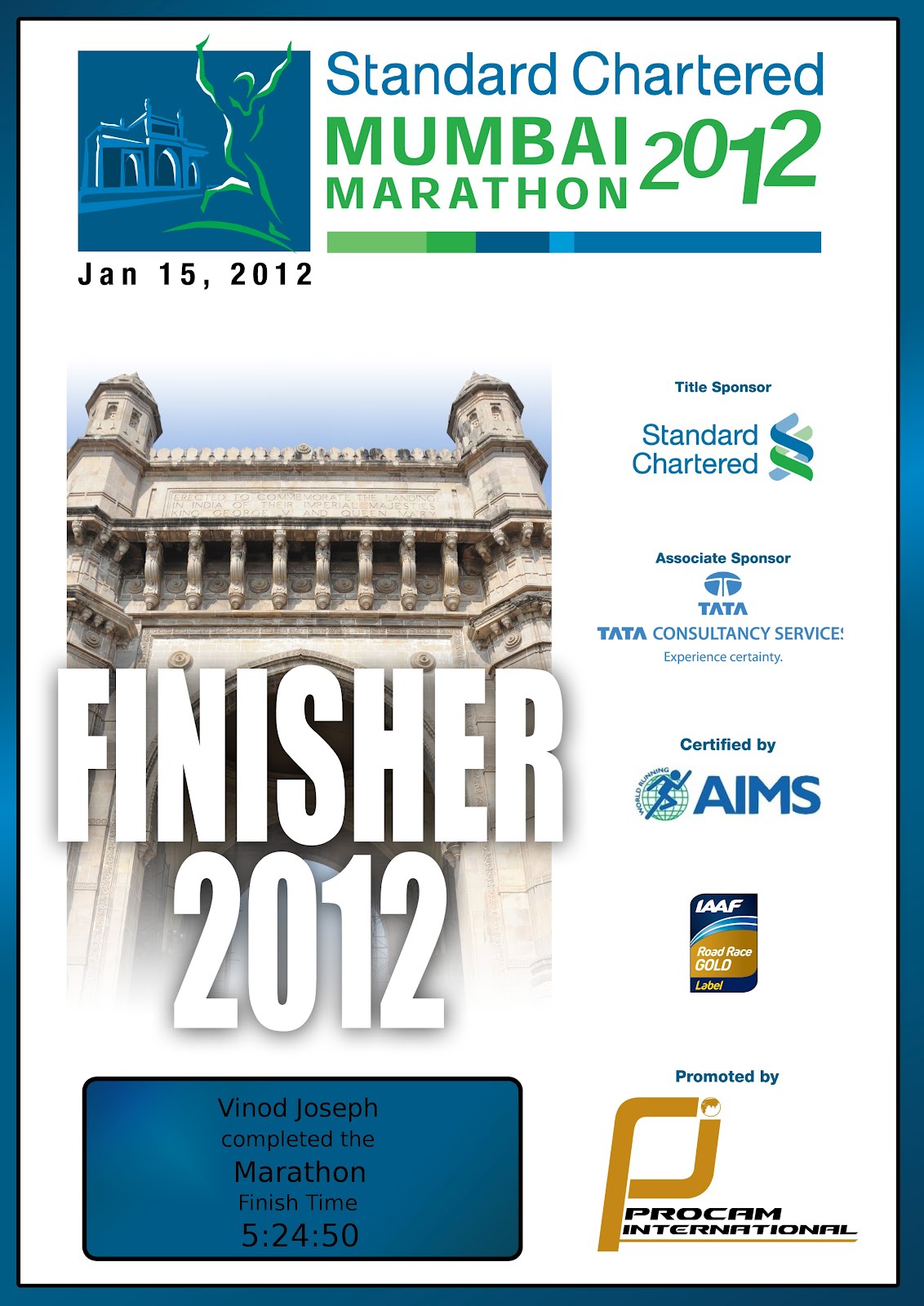
I completed the Standard Chartered Mumbai Marathon in Five hours, Twenty Four Minutes and Fifty Seconds.
Public Support
Words can’t describe the degree and extent of public support runners receive from the Mumbai public as they run the marathon. Not only do lots of people stand outside their compounds to watch the runners go past, many of them bring out trays of biscuits and chocolates to hand out. Occasionally there were bananas and oranges as well. I made it a point to accept chocolate bars from every kid who held it out to me, though I didn’t eat most of them and had to stuff them in my pocket. Since the bib on my tee-shirt had my name written on it, it was not unusual for kids to shout “Go Vinod Joseph Uncle Go” or “Run Vinod Joseph Uncle Run”.
After The Race
Most of the roads were still blocked and so I caught a train to Bandra and an auto rickshaw from Bandra station to my home. I was feeling fine and could walk at a reasonable speed. I took a nap in the afternoon and felt even better. However, the next day, my joints felt so stiff that I could barely walk. I went to work nevertheless and my colleagues had a laugh at my mincing penguin walk. The biggest damage was inflicted on my big toes, both of which turned a dark purple. I now understand that black toenails are a common hazard faced by runners when they run much longer than they have run before. This article has a detailed explanation of how and when long distance runners suffer from black nails. My nails are still discoloured and are in the process of being replaced by fresh ones. There is no pain.
My Next Marathon
I don’t think I am going to be one of those runners who run a marathon every month. Considering the fact that I have a job which requires me to put in long hours and also because I spend a fair amount of time blogging, writing short stories, book reviews and other stuff (my second novel is likely to be released in a couple of months from now), on a good week I barely manage to run forty kilometres. Most weeks I manage only twenty and sometimes I don’t run for days at a stretch. However I do want to run a marathon again and hopefully improve my timing. In all probability, I will run the Standard Chartered Mumbai Marathon again rather than take the trouble of travelling to a different city to run a marathon. I mean, when India’s best organised marathon takes place in my backyard, why run elsewhere?
Subscribe to:
Posts (Atom)