
I started learning French in 1999

I’ve been learning (or trying to learn) French since 1999 when I started working for a French multinational in Mumbai and Alliance Française’s French classes were offered for free. I finished Niveau Un (Level 1) in French when I moved on from that job and though my next job didn’t have a French connection, I persisted with my efforts to learn French, my long working hours and other personal commitments notwithstanding. My motivation? I had fallen in love with French. I signed up for Aliance Française’s Niveau Deux, listened to audio lessons and would go to the Theosophy Hall to watch French movies with subtitles. The Niveau Deux required me to attend classes in the morning from eight to ten, five days a week at Dhanraj Mahal in Colaba. Halfway through the three month course, I was forced to drop out after a M&A transaction I was working on required me to take a cab at eight thirty in the morning to reach a due diligence data room in far away Andheri. I continued learning French on my own using audio tapes and books.

A Diplôme
Supérieur
from the LSE
After I started an LLM at the London School of Economics (2002-2003), I went to the LSE’s Language Centre and asked for French language
courses. They made me take an assessment test and enrolled me for Niveau Trois,
which led to a Diplôme Supérieur after a year. By that time, I could speak passable
French (with some planning and deliberation) though I didn’t understand much of
what I received in response. After leaving the LSE, I started working in London
and slowly my French became rusty. Every once in a while, I would brush up,
only to lapse back to beginner’s level. Between 2005 and 20012, I made five
trips to France, each for around 5 days and before each trip, I could spend
some days working on my French, but those were mere splashes in the pool.

Then Duolingo happened
In March 2019, I started using
Duolingo to learn French. It was highly addictive and I was hooked. Initially,
I would spend just 15 minutes a day on Duolingo, but soon, I was spending up to
an hour every day. I was never into movies or cricket, but used to be a news
junkie. After I was hooked on Duolingo, I actually stopped watching TV
altogether to make time for Duolingo.
My hold over French grammar used
to be shaky. I could speak confidently, but with lots of grammatical mistakes.
With Duolingo, my grip over grammar improved substantially. When learning
French in a formal classroom with fifteen other students, you doesn’t always
get feedback on the grammar exercises you do in class or as homework. You get
to speak up or read a passage once in a while and get corrected. With Duolingo,
the feedback is instant.

Holiday in Paris
In May 2019, we went on a week’s
holiday to Paris, my sixth trip to France. Being able to speak French in Paris
is useful, especially with cab-drivers and in cafes. However, three months of
Duolingo hadn’t improved by ability to converse in French. In fact, I caught
myself hesitating a lot more than I used to. This was understandable, I
reasoned to myself. I was sure that once my grammar improved, I would get back
to speaking confidently as I used to, albeit without mistakes.
A break from Duolingo
On my return, my work load
increased and I cut back the time I spent on Duolingo to fifteen minutes a day,
until I ceased altogether, I think by around August or September 2019. I
stopped entirely more because it was addictive and sticking to a fifteen-minute-per-day
regime was annoying. It was either all or nothing and since I couldn’t spend
enough time with Duolingo, I stopped using it altogether. I did miss a lot though.
Reunited with Duolingo
Then in November 2020, my daughter announced that she would
take French at school, starting June 2021 and I happily went back to Duolingo
so that I could help her with her lessons. I started with fifteen or twenty
minutes and day and so I was spending all my free time on Duolingo. Once again,
I stopped watching TV altogether.
Scaling “Levels” and Acquiring “Skills”
Duolingo’s French course has nine “levels”, with between 24
to 30 “skills” in each “level”. To cross from one "level" to another, one has to cross a "checkpoint", which involves a test. Each skill involves a situation, such as “shopping”
or “at work” or “office” or “flirting” or “education” or “sports” and all
exercises in the skill involves such a situation. A “skill” could also be a
grammar topic, such as “passe compose (past tense)” or “Objects”. Each “skill”
has five levels and each level involves five or six exercises. Within each
“skill”, the “levels” are supposed to increase in difficultly and complexity as
one progresses from one to five. I found that the increase in difficulty is
marginal and some of the questions from the lower levels are repeated at the
higher “levels”.
In my first stint with Duolingo (March – August 2019), I used to finish all five “levels” in each “skill” before moving on to the next “skill”. In my second stint, I changed tack and started to do just one “level” of each “skill”, before moving on to the next skill. Finishing one “level” (out of five “levels”) of a “skill” is sufficient to get permission to move to the next “skill”.
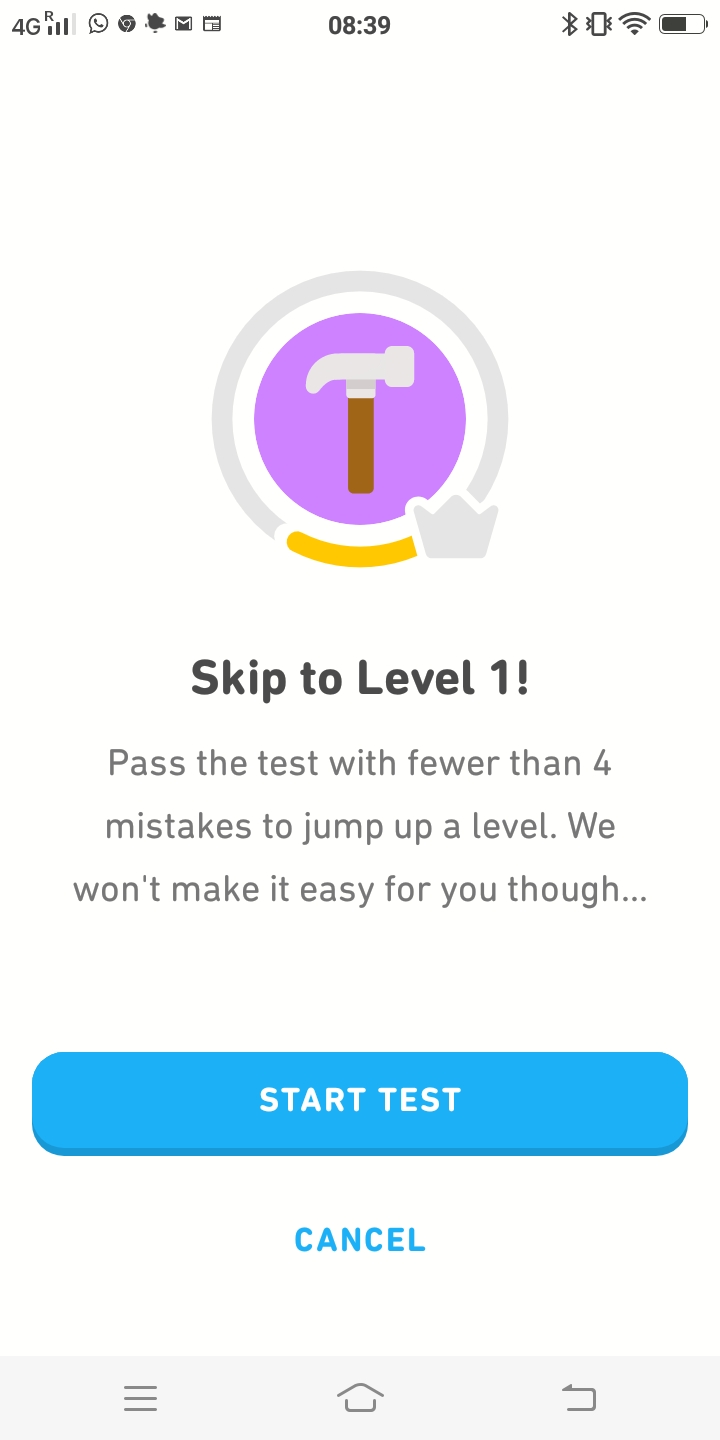
It is also possible to complete a level without completing all the (five or six) exercises in the “level” by taking a test. If you make four mistakes in the test, you flunk, but you can repeat the test immediately. Soon, I found that most of the time, I could clear the test for a “level” after doing one exercise.


Is it an addiction?
Duolingo functions by making the
user addicted to the learning process in various ways, which is both a good
thing and a bad thing. It is a good thing because you enjoy and look forward to
using Duolingo. It is a bad thing because, as I came to realise very slowly,
you don’t learn much if you play with an app to earn rewards and XPs and to
maintain a streak.
Quest for XPs
When one learns
a language on Duolingo, one earns experience points, which are called “XP” for
short. A single lesson to acquire a “skill” or a general practice session gets
you at least 10 XP and usually there are bonus XPs. When you complete all five
levels in a “skill”, you get XP. When
crossing from one level to another, there’s a quiz to be taken and if you are
successful, you get 50 XP. Then there are Duolingo Stories which are actually
quite good and the XP ranges from 14 to 28.
When you start using Duolingo, you choose a daily goal for
earning XPs. Casual is 10 XP, Regular is 20 XP, Serious is 30 XP and Intense is
50 XP.

Leaderboards
Every user is placed on a “leaderboard”. The top ten XP
performers of a league are promoted to a higher tier for the next week. One
starts with Bronze and progresses through Silver, Gold, Sapphire, Ruby,
Emerald, Amethyst, Pearl and Obsidian until one gets to the Diamond league. I
progressed steadily, occasionally falling back. I got the Diamond league a few
times and once I topped the Obsidian.


Your fellow learners on your leaderboard may not be learning
the language that you are learning. The only two common factors are that you
are on Duolingo and you are hungry for XPs.
Once addicted, one goes way past the daily XP goal, in order
to be go up the leaderboard.
If you don’t keep up, others get to know of it.


Rewards
There are a number of rewards on Duolingo, for reasons
ranging from frivolous (adding a profile picture (Photogenic), practising on a
weekend (Weekend Warrior), following three friends (Friendly), reading a tip
(Strategist)) to more serious shit, such as earning 30,000 XP (Sage), learning
2,000 new words in a single course (Scholar), making it to the Diamond League
(Champion), completing 100 lesson without a mistake (Sharpshooter), Finishing
#1 in the Diamond League (Legendary), finishing #1 in my leaderboard (Winner),
reaching a 125 day streak (Wildfire) and earning 2 crowns in every “skill” in a
course (Conqueror).


I am Photogenic, a Weekend Warrior, Friendly, a Strategist,
a Sage (though I’m pretty sure I don’t know 2000 French words), a Scholar, a Champion,
a Sharpshooter and a Winner. The only three rewards I haven’t got are Wildfire,
Conqueror and Legendary.
Maintaining a Streak
If you keep hitting your daily XP target for more than a day, you are on a streak. If you do it for two days, you are on a two day streak, if you do it for ten days, you are on a ten day streak, if you do it for eighty days, you are on a eighty day streak. Folks who use Duolingo often boast about their steak on social media such as LinkedIn and Facebook, I guess it shows that they are consistent and persistent. Duolingo not only encourages you to maintain a streak, it has various aids to help you maintain your streak.

You
can buy a weekend amulet to make sure that your streak is not lost if you fail
to practice during the weekend.


If you make a mistake
If you make a mistake during a lesson, you immediately get to see the correct answer and the lesson doesn’t end until you do it right, which is easy since you have seen the answer.


If a lesson has fifteen questions
and you get questions five, eight and twelve wrong, then after the fifteenth
question, questions five, eight and twelve will pop up again and you know what
the correct answer is. So, there is no incentive is pondering over a question
to get it right. Instead, the temptation is to answer it somehow, see the
correct answer, move on and answer the same question towards the end.
Dual choice questions
When there is one blank and two choices, the correct answer
is always the second one.


When there are two blanks and two choices, the second choice
always goes into the first blank.


Jumbled sentences
A bulk of the exercises involve choosing words from amongst a pile to form a correct sentence. Even if one doesn’t know French, it is possible to form the correct sentence.


However, I assume, the exposure to the
words teaches you something. Unless you are in a tearing hurry and only want to
get XPs.
One of the mistakes I made most often when forming sentences
from out of jumbled words was using “the” instead of “this”.


English meanings for French words
When doing an exercise, one can learn the meanings of French
words by clicking on them. So, answering a question is pretty easy.


Constant encouragement
As one learns, one is constantly encouraged in various ways. If one spends thirty minutes on Duolingo, one’ll be encouraged in at least five different ways.


The next day, the same messages of encouragement pop up. I started to find the
messages annoying or condescending.
You are encouraged to encourage those you follow and you
receive encouragement from them in turn.


Oral practice
If you use the Duolingo app on your smart phone, a big chunk
of the exercises are oral.


Alternately, you need to listen to a French sentence and
then pick words from out of a pile to form it.


Hard exercises

After the first few levels, each lesson has two tough
questions at the fag end. Usually, these are tougher than the preceding
questions.


Diverse, Funny, Whacky and Weird
One of the best things about Duolingo is the sheer diversity
of the topics used to teach French.


Mauvais Anglais
Once in a blue moon, the English doesn’t make sense or read too well.

Playing and skimming, not diving
I realised that I was playing with French, skimming through
exercises, not diving deep enough. When I think back to the French classes I
had at the Alliance Francais de Bombay or at the LSE’s Language Centre, I
realise that the lessons there gave me lots of time to think and made me look
for answers. I am pretty sure that, though I learned a lot of new words on
Duolingo, I don’t remember most of them and my entire French vocabulary dates
back from my pre-Duolingo days.
Duolingo Stories
These are distinct from “Skills”, but are easy to do and
generate a lot more XPs. More than on one occasion, when I was in the Obsidian
league and wanted to get into the Diamond league, I found myself doing more “stories”
than lessons and it worked. I moved into the Diamond league. Some of the
stories are really good and most of the characters are good and real. If I were
in search of entertainment, I would give these stories five stars.
One particular story of an office worker sneaking into her
boss’s cabin to read a document on his computer (which had a list of
promotions) was especially engrossing.

Diversity
Duolingo’s characters are diverse in various ways.


Vikram and
Priti, who are vegetarian, are an integral part of the French speaking cast.

As Free As the Air
Duolingo is free to use – one only needs to register.
However, Duolingo Plus requires payment and one gets to use Duolingo without
being interrupted by ads.

If you refer a friend who signs up to join Duolingo, then you get Duolingo Plus for a couple of weeks.

During my first stint with Duolingo, I
got Duolingo Plus for a couple of weeks twice by referring friends.
Exit from Duolingo
I haven’t used Duolingo since July 11, 2021. Though I didn’t use Duolingo since July 11, 2021, I used my streak freeze for a few days after that. I kept getting various reminders, through app notifications and by email, to keep my streak frozen.


On July 17, 2021, my streak stays frozen. If I use Duolingo on July 18, 2021 and accumulate 50 XP or more, I will have a 83 day streak, despite not having used Duolingo for six days.
Will I return to Duolingo?
I think I will return to Duolingo
sooner than later.
Duolingo is an incredible resource, the best free resource to learn a foreign language that is currently available online. However, to really learn French and to make optimum use of Duolingo, I need to train myself to not to focus on XPs or streaks or my position on the leaderboard and to couple my Duolingo lessons with watching TV5, reading French newspapers and practising French with other French wannabes.


 Posts

